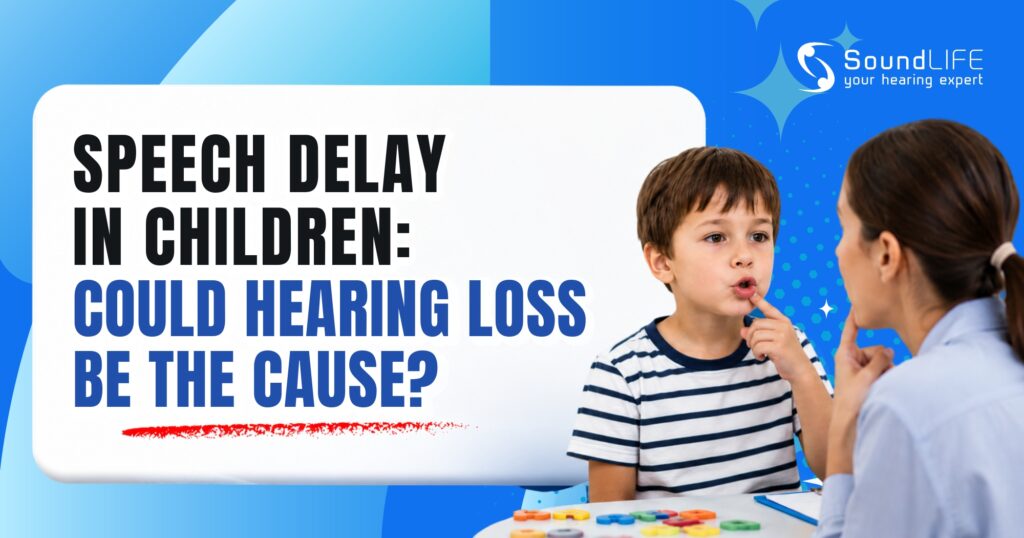
When a child isn’t speaking as expected, many parents wonder whether it’s “just a late talker” or a sign of something more. While speech delay can have many causes, one commonly overlooked factor is hearing loss.
A child learns to speak by listening. If they cannot hear speech sounds clearly, learning language becomes much more difficult. The earlier hearing loss is detected, the better the chances of helping your child develop communication skills and reach their full potential.
In this article, we’ll explain how hearing loss affects speech development, the warning signs parents should look for, and why newborn hearing screening and children’s hearing tests are essential.
Can Hearing Loss Cause Speech Delay?
Yes. Hearing loss is one of the leading medical causes of speech and language delay in children.
Children learn language by hearing voices, words, and everyday sounds around them. Even a mild hearing loss can make it difficult for a child to hear certain speech sounds clearly. Over time, this can affect:
Speech development
Vocabulary growth
Language understanding
Learning and academic performance
Social interaction
Confidence and behaviour
The earlier hearing loss occurs, the greater its impact on speech and language development if left untreated.
How Hearing Works in Speech Development
From birth, babies are constantly learning through sound.
They listen to:
Their parents’ voices
Everyday conversations
Music
Environmental sounds
Different speech patterns
By hearing these sounds repeatedly, babies gradually learn how words are formed and eventually begin speaking.
If hearing is reduced—even slightly—the brain receives incomplete speech information. As a result, children may struggle to imitate sounds or pronounce words correctly.
Signs Your Child May Have Hearing Loss
Many children with hearing loss appear perfectly healthy, making the condition easy to miss.
Watch for these signs:
Babies (0–12 months)
Does not startle to loud sounds
Does not turn towards voices by 6 months
Does not babble consistently
Does not respond when their name is called
Seems unaware of everyday sounds
Toddlers (1–3 years)
Delayed speech development
Uses very few words for their age
Frequently says “Huh?” or “What?”
Watches people’s lips while they speak
Turns the TV volume up loudly
Doesn’t respond unless spoken to face-to-face
Preschool Children
Unclear speech
Difficulty following instructions
Frequently misunderstands conversations
Easily distracted
Learning difficulties
Complains that people are mumbling
Not every child with speech delay has hearing loss—but every child with speech delay should have their hearing evaluated.
Hearing Loss Can Be Present From Birth
Many parents assume they would notice if their baby couldn’t hear.
Unfortunately, this isn’t always true.
Some babies are born with hearing loss that is not immediately obvious. Others develop hearing loss during infancy due to:
Ear infections
High fever
Certain viral infections
Genetic conditions
Premature birth
Jaundice requiring intensive treatment
Exposure to certain medications
Because hearing loss is not always visible, newborn hearing screening is strongly recommended for every baby.
Why Newborn Hearing Screening Is So Important
Newborn hearing screening is a quick, safe, painless test performed shortly after birth.
Its purpose is to identify babies who may have hearing loss before speech delay develops.
Early detection allows intervention to begin during the most critical period of brain and language development.
Research consistently shows that children identified and treated before 6 months of age have significantly better language outcomes than those diagnosed later. This
Evidence forms the basis of the Joint Committee on Infant Hearing’s internationally recognised 1-3-6 Early Hearing Detection and Intervention (EHDI) guidelines, which recommend:
Hearing screening by 1 month
Diagnostic audiologic evaluation by 3 months
Appropriate intervention by 6 months
My Baby Passed the Newborn Hearing Screening. Do They Still Need Hearing Tests?
Yes.
Passing newborn screening only means your baby’s hearing was normal at the time of testing.
Some children develop hearing loss later due to illness, recurrent ear infections, genetic conditions, or progressive hearing loss.
Parents should seek a hearing assessment if they notice:
Delayed speech
Poor response to sounds
Frequent ear infections
Family history of hearing loss
Concerns raised by teachers or childcare providers
What Happens During a Children’s Hearing Test?
At Soundlife Hearing, children’s hearing assessments are designed to be child-friendly, comfortable, and age-appropriate.
Depending on your child’s age, the assessment may include:
Video otoscopy to examine the ear canal
Tympanometry to assess middle ear function
Behavioural hearing tests (Visual Reinforcement Audiometry or Conditioned Play Audiometry)
Pure Tone Audiometry for older children
Otoacoustic Emissions (OAE)
Auditory Brainstem Response (ABR) or Auditory Steady-State Response (ASSR) for babies or children who cannot complete behavioural testing
Our audiologists will explain the results clearly and recommend the most appropriate next steps.
What If My Child Has Hearing Loss?
A diagnosis of hearing loss does not mean your child cannot learn to speak.
With early intervention, many children develop excellent speech and language skills.
Treatment depends on the type and severity of hearing loss and may include:
Medical treatment by an ENT specialist
Monitoring of hearing
Speech and language therapy
Hearing aids
Family communication strategies
Regular hearing review
The key is early identification and timely intervention.
Can Hearing Aids Help Children with Speech Delay?
If hearing loss is contributing to your child’s speech delay, hearing aids can make a significant difference.
Modern pediatric hearing aids are designed specifically for children and can:
Improve access to speech sounds
Support speech and language development
Enhance learning in school
Improve social communication
Increase confidence
Children who receive hearing aids early generally achieve better communication outcomes than those whose hearing loss is identified later.
When Should Parents Arrange a Hearing Test?
Arrange a hearing assessment if your child:
Is not meeting speech milestones
Has unclear speech
Frequently asks people to repeat themselves
Has recurrent ear infections
Failed newborn hearing screening
Has a family history of hearing loss
Shows behavioural changes related to listening
Has concerns raised by teachers or doctors
Trust your instincts. If you are worried about your child’s hearing, it is always worth having it checked.
Early Detection Changes Lives
Speech delay is not always caused by hearing loss—but hearing loss should never be ruled out without proper testing.
The earlier hearing problems are identified, the sooner children can receive the support they need to communicate, learn, and thrive.
If you have concerns about your child’s speech or hearing, don’t wait.
A comprehensive hearing assessment can provide answers and peace of mind.
Book a Children’s Hearing Test at Soundlife Hearing
At Soundlife Hearing, our experienced audiologists provide comprehensive hearing assessments for babies, toddlers, and children using age-appropriate techniques and advanced diagnostic equipment.
Whether your child has speech delay, recurrent ear infections, or you’re simply seeking reassurance about their hearing, we’re here to help.
Early hearing checks can make a lifetime of difference. Contact Soundlife Hearing today to schedule your child’s hearing assessment